5,000-year-old Stonehenge ‘prototype’ alignment discovered
Just in time for the summer solstice, a potential Stonehenge prototype has been discovered.

A reconstruction of summer solstice celebrations as they might have appeared at Bulford 5000 years ago (Marijane Porter, Wessex Archaeology).
Stonehenge is the world’s most famous ceremonial monument and a work of technological genius that aligns with both the summer and the winter solstice. But how did they get this alignment perfect? Today, I have a brand new discovery to share: archaeologists might have discovered the prototype of Stonehenge. I’m Louise, an archaeologist and Wessex Archaeology invited me to the exciting press conference, so I have all the details of this once-in-a-lifetime discovery: where it was, where it fits in the story, how these people celebrated, and the incredible science behind it.
If you prefer to watch your long-form content, I have a YouTube video available on this discovery: https://youtu.be/D5iZBHMN0Iw
Just 5km from Stonehenge is the site of Bulford in Wiltshire. A team from Wessex Archaeology, led by Time Team’s Phil Harding, discovered two post holes, 1 meter deep and located 120 meters apart. These would have each held a wooden post about 3-4 meters high and up to 0.5 meters thick. A relatively simple but substantial monument.
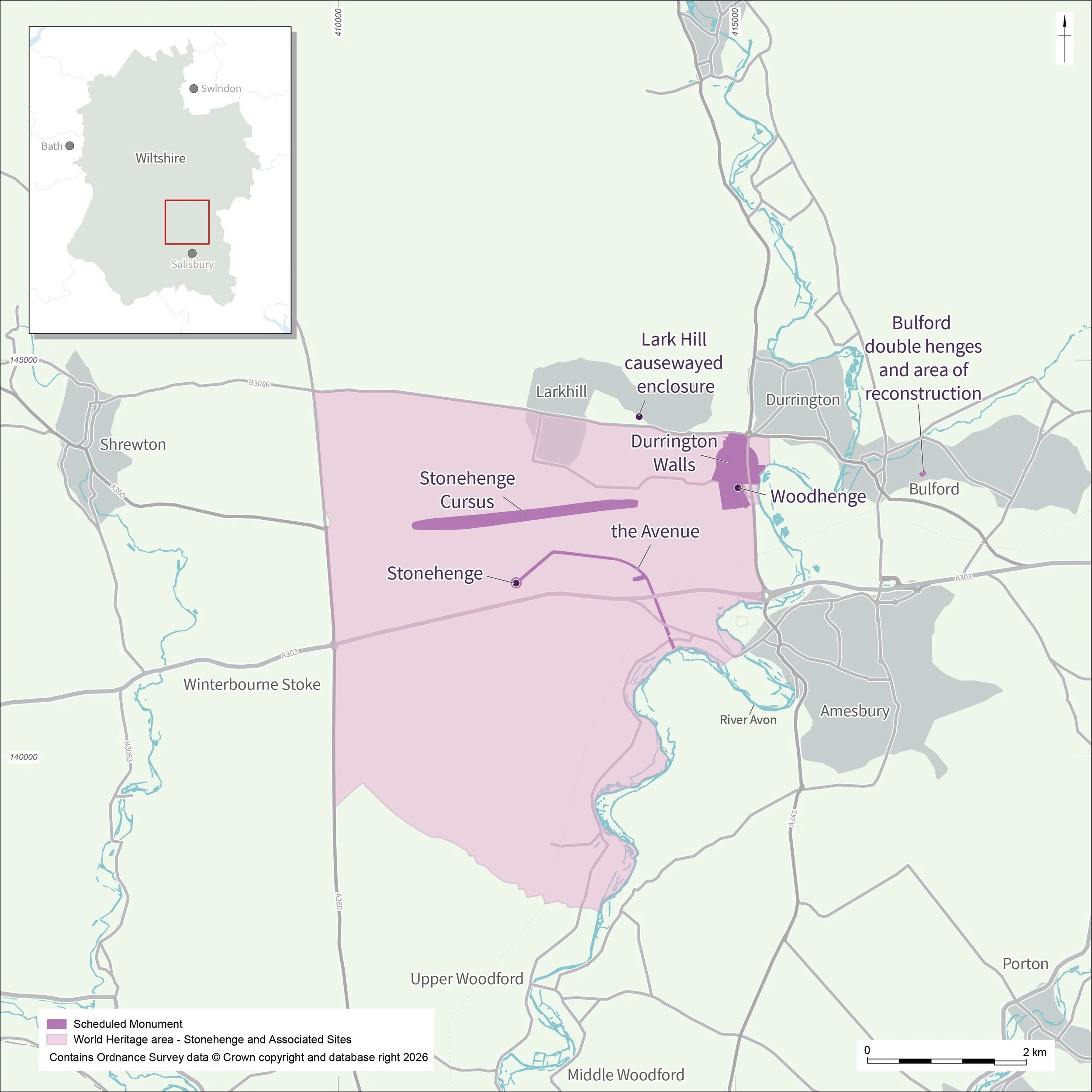
Overview map of Bulford situated in the wider Stonehenge landscape (Marijane Porter, Wessex Archaeology).
However, what makes this extraordinary is that the posts were positioned to form a line pointing directly at the sun during the solstices. Groups of prehistoric people, not just the Wiltshire locals, gathered around the posts to watch the sun align with this impressive structure, 500 years before the sarsen stone structure at Stonehenge. This is the earliest known solstice alignment in the Stonehenge landscape.
This landscape’s proliferation of celestial alignments has captured the human imagination for millennia. In a few days, Stonehenge will be filled with people gathered to celebrate the Solstice in 2026. Nearby the entrance of Lark Hill, an early Neolithic enclosure dated to 3700 B.C., broadly faces northeast with the midsummer sun rising dead ahead over Sidbury Hill. Similarly, phase one of Stonehenge’s entrance (dated to 3000 B.C.) broadly faces towards the midsummer sunrise. These sites have no specific alignments, no structural settings, just facing with respect to the solstice. There was later an exponential increase with sites like Woodhenge, Durrington Walls, Stonehenge Avenue, and the Sarsens at Stonehenge, moving from generally looking at the solstice to specific complementary alignments.
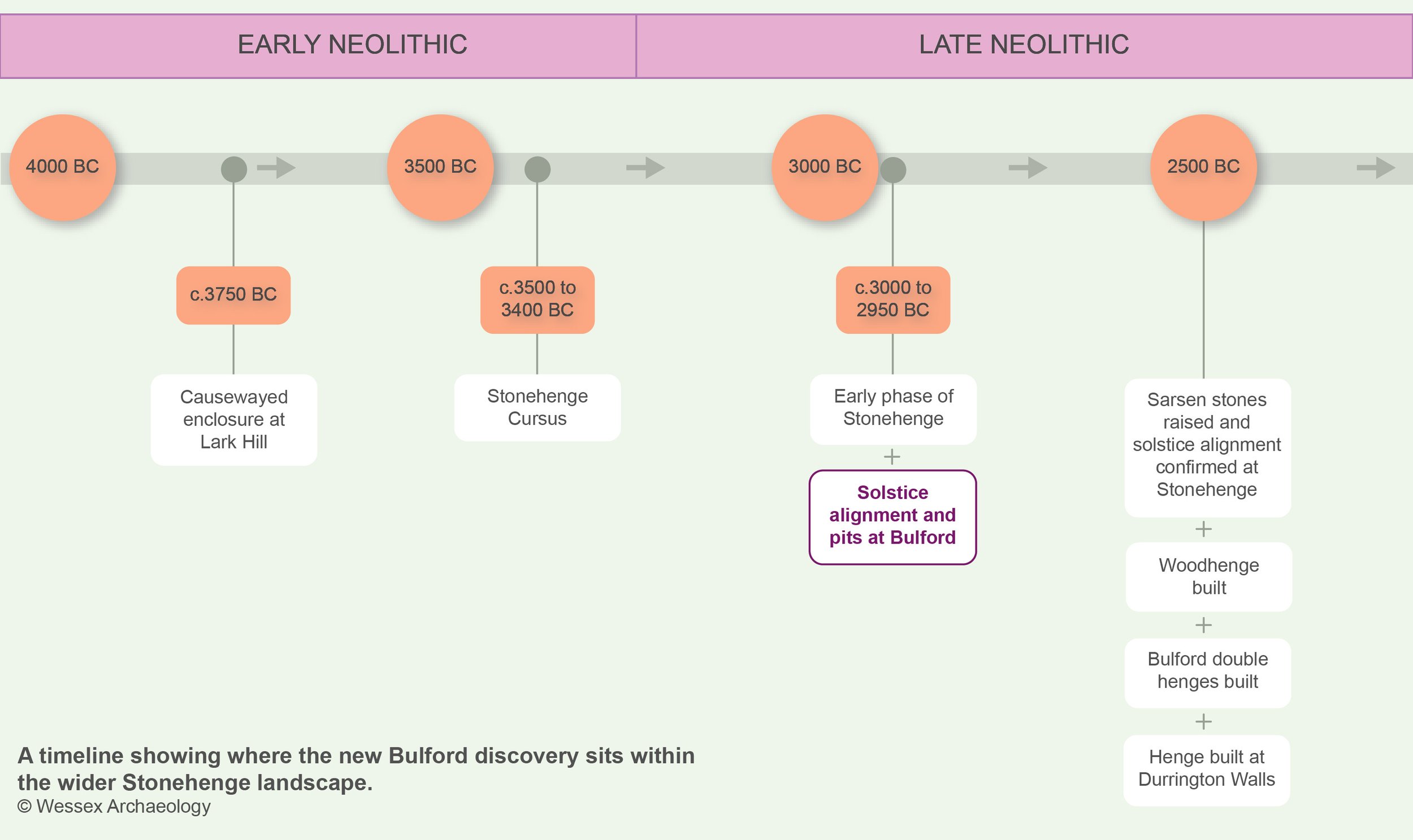
Timeline showing where the new Bulford discovery sits within the wider Stonehenge landscape context (Marijane Porter, Wessex Archaeology).
Bulford is the first instance of facing both the summer and the winter solstices. It is the first actual proof that people were capable of measuring the alignment. This structural setting is an important part of the story of this human activity across millennia. These structures, which have no practical, utilitarian purpose, are the religion of the Stone Age, manifesting in earth, stone and wood. We don’t have a name for this sun worshipping, but this is how prehistoric people understood their place in the cosmos and how the universe works. The who, what and why of this religion are unknown and left to our speculation. However, the questions of where and how are becoming clearer…
At Bulford, the posts were not just a structure, but a gathering point for a community to celebrate the solstices before more complex, permanent structures could be built. A large number of people gathered here for potentially a few decades worth of solstices, evidenced through the 48 pits discovered on site, which included a wealth of pottery, animal bone, worked flint and charcoal. Some of the animal bones found include aurochs bone, the giant, wild and extinct ancestor of the modern cow. While difficult and dangerous to hunt, the auroch rewarded them with enough meat to feed almost 300 people. We are invited into a scene of celebration and feasting through the auroch bone.

Neolithic Woodlands Pottery Found in Bulford, Wiltshire. A great example of the 'Woodlands' sub-style. (Wessex Archaeology)
Lipid analysis showed the pottery fragments contain animal fats like pig fat and dairy fat. This specific pottery style is also unusual. The assemblage of Woodlands-style pottery from this site is one of the largest groups from southern Britain. However, the origin of this pottery is from Orkney and the rare motifs on these fragments are indistinguishable from Orcadian examples. Yet, they are made of local Wiltshire clays, perhaps suggesting the movement of people, maybe even potters.
Winter Solstice Animation by Dr Fabio Silva
This animation provides a window into what the community gathered here would have seen in 2950 B.C. The people viewing from roughly 20 meters away, watching the sun alight the posts to one degree of accuracy. One pit may represent a viewing area, where an extremely rare disc-shaped knife was discovered, potentially placed here as a symbolic reference to the sun disc.

Disc shaped flint knife found at Bulford by Phil Harding of Wessex Archaeology
The original excavation took place between 2015 and 2017 as part of the Ministry of Defence’s Army Basing Programme, and the site is not visitable today. Archaeologists discovered the conical-shaped post holes that each would have taken two people a day’s work to create. One person would have been in the hole, and one outside to collect the chalk and rubble. Charcoal in one pit is from an ash tree, which is plentiful in the local chalk landscape, that grows in nice straight poles. Ash would be an ideal candidate for a construction like this. In modern paganism, ash has significance, so who knows if the origins of this extend deeper into time. Charcoal might mean charring the post to preserve it for more than a year. Backfill evidence suggests the site was dismantled, with the posts taken out, not rotting away on site. Phil was excavating one of these postholes and later in the excavation drew a line with his ruler connecting the two, noticing the alignment was 50 degrees off north, very excitedly recognising this might be on the line of the solstice.
Dr Fabio Silva, who is a leading skycape archaeologist, was called in to investigate. The first thing he did was reconstruct the landscape without any houses or vegetation to see what it would have looked like 5000 years ago, to make sure there was no hill blocking the view, which would have made the theory void. Next, he added the posts into the landscape, accounting for the range of height, 3-4 meters, and width, up to a maximum of 0.5m. Using hundreds of years of accurate astronomy data, the same as NASA uses to launch satellites, he added the sky. Within reason, this software can be used to recreate the sky at any time and place in the world. By looking at this location 5,000 years ago, it proved that this solstice alignment exists. He created these animations, which are similar to what will be seen at Stonehenge in a few days.
Could this be a coincidence? Only two post holes are at this site. They are contemporary, only around 100 meters apart, and within a degree of accuracy. The odds that this alignment happened by chance are 1 in 2000, and you are situated in a landscape that has these alignments, demonstrating that this isn’t a coincidence.
The people at Bulford likely could have been connected to Phase One of Stonehenge. There may have even been posts like this at Stonehenge that have been lost due to later activity. The stones of Stonehenge aren't the beginning of a ceremony, but the upstanding remains of a deep tradition of prehistoric people. Phil called this ‘one of the greatest finds’ of his career. It is discoveries like this that are why I love archaeology, as the story is never complete, and people in the distant past lived lives full of culture and knowledge.
The findings are due to be published later this year, and this is apparently one of several amazing discoveries, so watch this space. Thank you to Wessex Archaeology for inviting me to the press conference and for the assets used in this post.
