God’s Forge or Ancient Tomb? | Wayland’s Smithy
Imagine you are travelling along the ancient Ridgeway and your horse has lost a shoe. Nightfall is fast approaching. What do you do? Well, legend has it that if you come here, tether your horse and leave a coin, provided you do not watch, by morning the coin would be gone and your horse would magically be reshod by an invisible blacksmith. Wayland the Smith is this legendary blacksmith, a notable figure of Norse, Anglo-Saxon, and Germanic mythology and is famously depicted on the Franks Casket. The Saxons who settled this area likely inscribed his name on this monument, Wayland’s Smithy. The name was first recorded in an early medieval land deed from 908 AD, documented in a charter from King Eadred in 955 AD. However, the Saxons were not the builders of this structure; for them, we have to go 4000 years earlier.
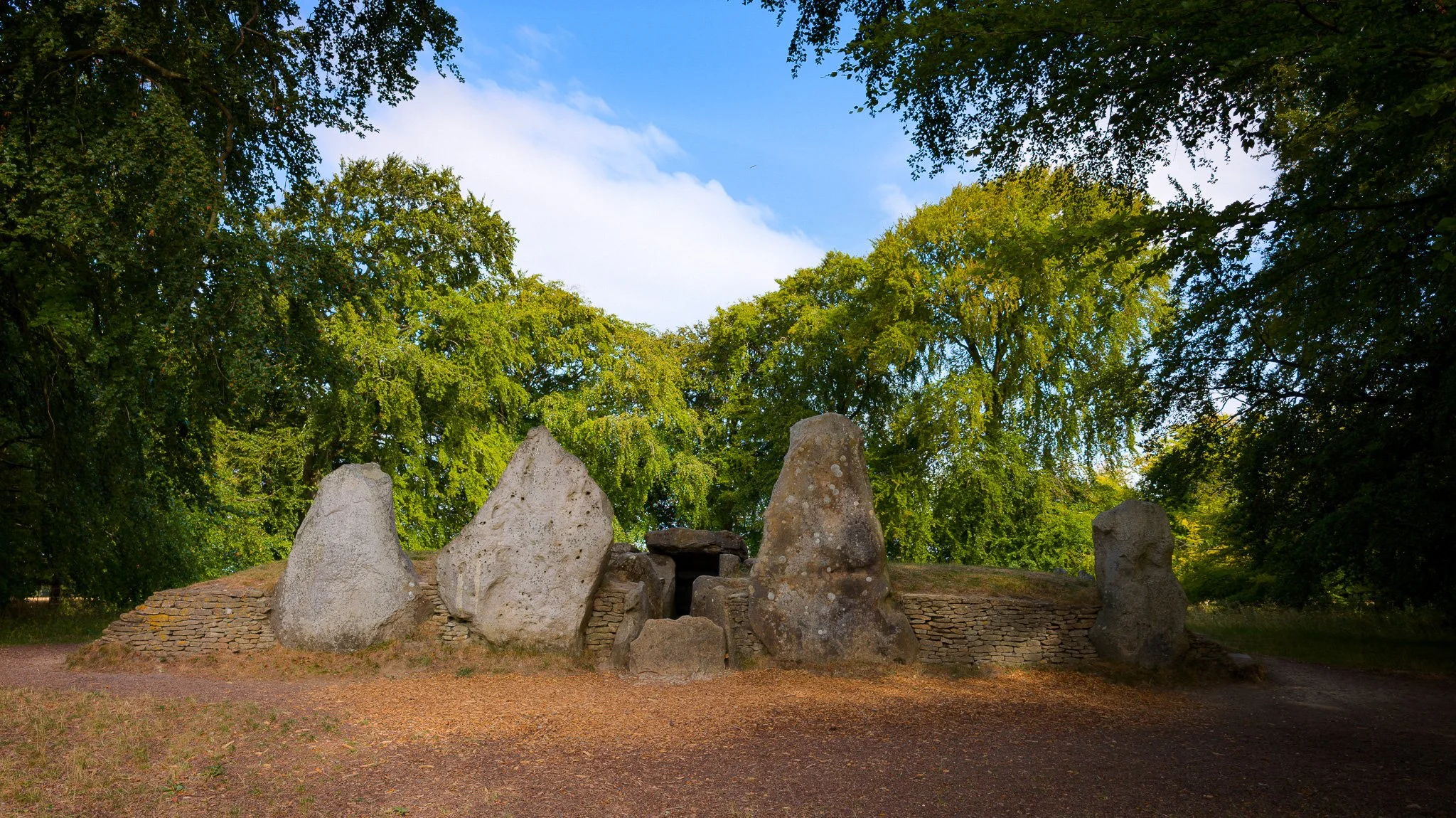
Photograph of Wayland’s Smithy I took in July 2026.
Long barrows are the first monuments ever built in Britain and often contain human remains in their chambers, meaning they have been interpreted as tombs. Over 300 have been discovered, and Wayland’s Smithy is one of the most famous examples. The barrow sits along the Ridgeway, a path frequently referred to as ‘Britain’s oldest road’, and shares the hills with the Uffington White Horse and Iron Age Hillfort. The Avebury landscape is also just 25km southeast. Wayland’s Smithy also belongs to a particular style, the Cotswold-Severn style; these are typically chambered and contain comparatively larger quantities of human bone, averaging 40-50 people in each. It features the distinctive trapezoidal mound made of chalk and earth, measuring just under 55 meters long. This material would have come from flanking side ditches. A continuous kerb of sarsen stones defines the perimeter of the mound, which would have originally likely been bright white from the chalk. Within the southern end of the mound is the chamber. It has a narrow and partially constricted passage, leading to a pair of small side chambers aligned east-west. At the entrance of the chamber is a megalithic façade where four sarsens remain, but originally there would have been six.
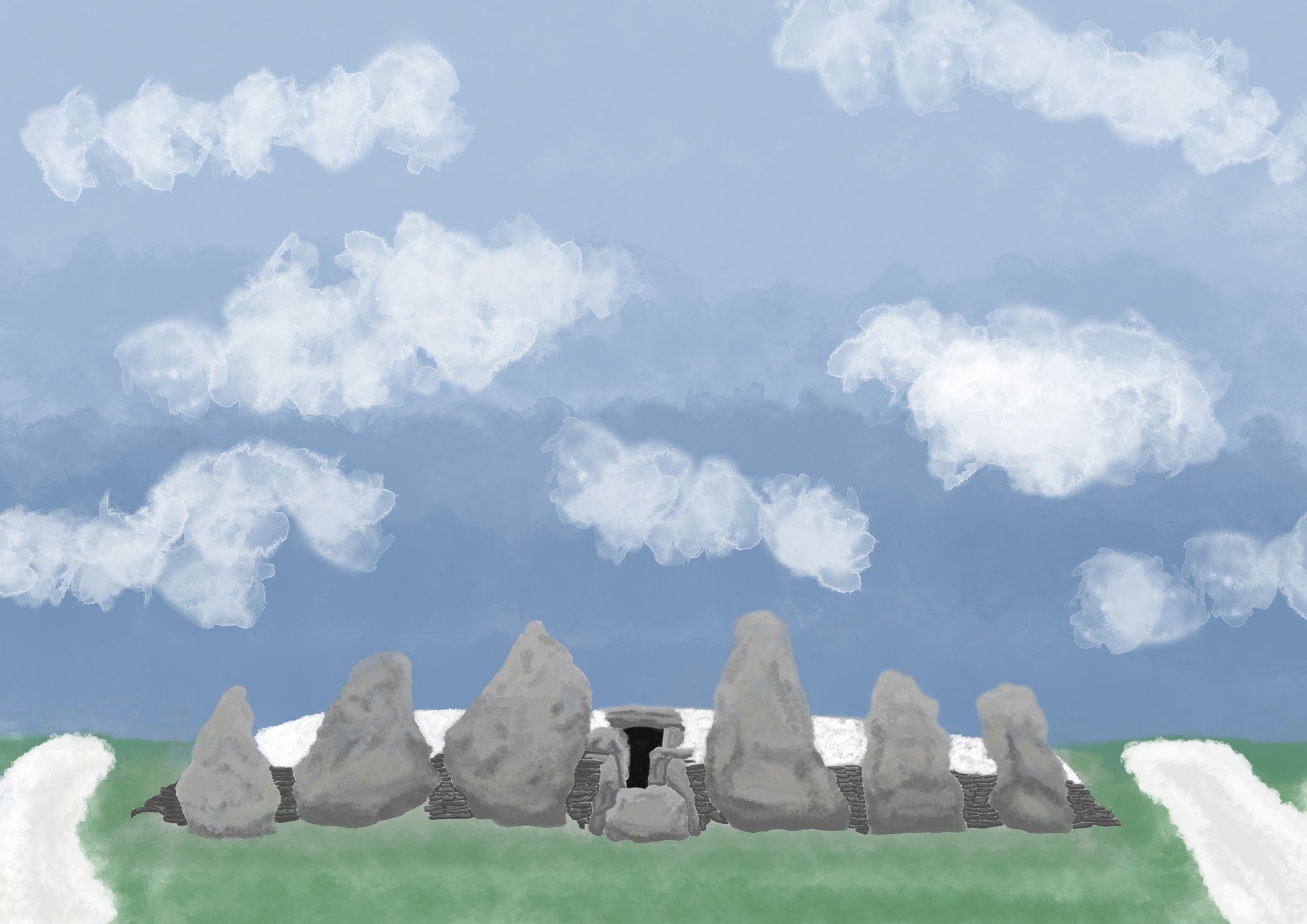
Reconstruction illustration of Wayland’s Smithy II (by me!)
Excavations in 1919 and 1920 found that the chambers had been ransacked in previous centuries, but they still contained the, albeit jumbled, remains of several people, including men, women and children. However, later excavations in the 1960s revealed that the monument we see today had been built over an earlier oval barrow.
Wayland’s Smithy I
This first construction had a box-like mortuary structure made of wood and stone, featuring a rectangular paved area of sarsen slabs with two split tree trunks at either end, with human remains placed inside. A single crouched articulated burial was placed at one end, and in front were the mostly disarticulated remains of the other people. Articulated means bones found in their natural, connected anatomical position during an excavation. Meaning in an intact burial, an individual was placed when the soft tissue still connected their skeleton. Immediately to the south of the mortuary structure, a double row of small postholes was interpreted as a raised exposure platform for excarnation, where bodies may have been left to decompose before being placed in the chamber. In total, 14 people were laid to rest in this monument: eleven men, two women and a child. The first was placed in roughly ~3590-3555 BC, and the last in ~3580-3550 BC. This means the barrow was used for no more than 15 years, less than a single generation and potentially a single year.
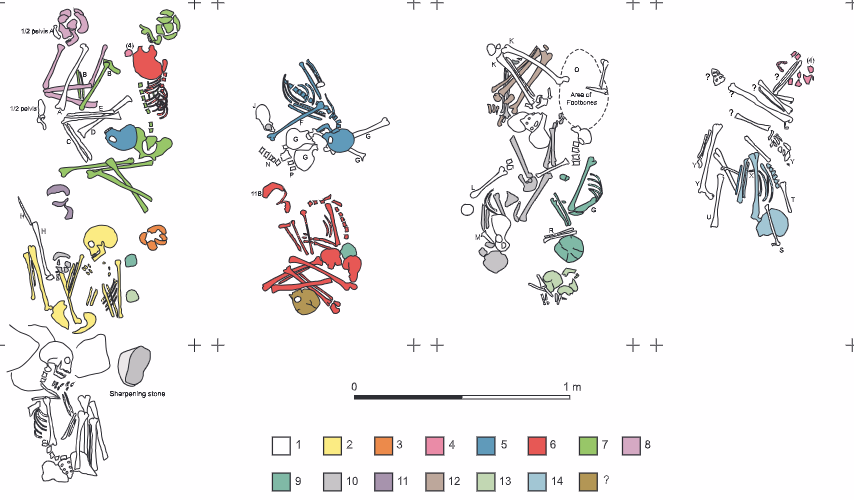
Skeletal Remains Wayland’s Smithy I (Whittle et al. 2007)
What were the circumstances that led to a group of people being buried in such a short period of time? Maybe there was an outbreak of disease or these people died from injuries. However, I think the answer is likely violence. Three leaf-shaped arrowheads were discovered during excavation. These being votive offerings is unlikely, as crucially the tips were missing, usually meaning it has been fired and hit a hard target. Three individuals or more individuals likely suffered lethal arrowhead strikes. An embedded flint projectile tip in a hip bone of bone group 12 would have entered through the abdomen, and there is no evidence of bone healing. We can likely never know for sure; evidence of violence like arrowhead strikes leaving unequivocal evidence in the bone is unlikely, but we can still speculate. I have a video coming out in the next few months delving deeper into the function of long barrows.
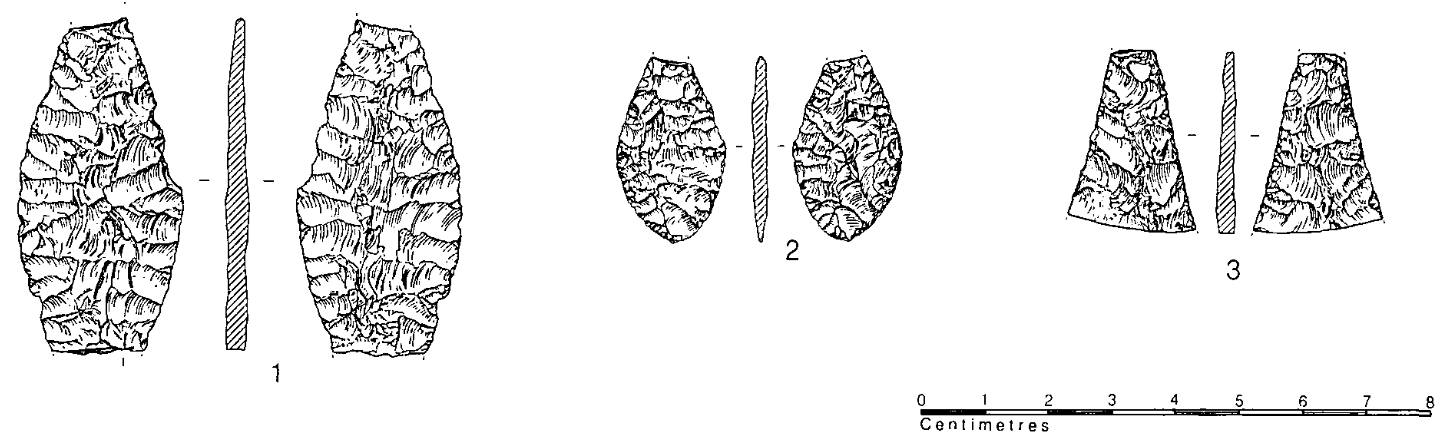
3 Arrowheads Wayland’s Smithy I (Whittle et al. 1991)
I also wonder what the relationship between these people was? To my knowledge, there hasn’t been DNA testing, but at Hazleton North, another Cotswold-Severn long barrow, the oldest family tree was uncovered with 27 individuals revealed as biological relatives from five continuous generations of a single extended family. Could the people in Wayland’s Smithy I also have been a family of early farmers? Do we have a family killed in some violent event and quickly interred in a significant monument by their community?
After 40 to 100 years, the structure was covered by an oval mound of chalk and earth, derived from two flanking ditches. However, it wasn’t forgotten.
Wayland’s Smithy II
After another gap of just 1-35 years 1-35 years, in around 3460-3400 BC, the second phase of the monument, Wayland’s Smithy II, was constructed, burning the earlier structure. It was set out on the same alignment but at a much larger scale. The chamber only takes up a small section of the mound and consists of a narrow and partially constricted passage, leading to a pair of transepted chambers aligned east-west. Unfortunately, very little can be said about the people who were laid inside. At the entrance was an exceptional megalithic façade of large, upright sarsens; the only other monument to have this is West Kennet. However, dating of Wayland’s Smithy II puts it at 200 years younger than West Kennet, which lies just 25km southeast. Perhaps the builders wanted to echo the spiritual significance of long-established traditions, maybe linking themselves to this earlier group of people living in the Avebury landscape. The monuments' use probably extended to the middle decades of the thirty-fourth century BC, and then it was later picked up by folklore.
https://www.english-heritage.org.uk/visit/places/waylands-smithy/
Fowler, C. et al. (2022). A high-resolution picture of kinship practices in an Early Neolithic tomb. Nature, 601 (7894), Springer Science and Business Media LLC., pp.584–587.
Schulting, R. J. and Wysocki, M. (2005). ‘in this chambered tumulus were found cleft skulls …’: An assessment of the evidence for cranial trauma in the British Neolithic. Proceedings of the Prehistoric Society, 71, Cambridge University Press (CUP)., pp.107–138. [Accessed 4 August 2026].
Whittle, A. et al. (1991). Wayland’s Smithy, Oxfordshire: Excavations at the Neolithic tomb in 1962–63 by R. j. c. atkinson and S. piggott. Proceedings of the Prehistoric Society, 57 (2), Cambridge University Press (CUP)., pp.61–101.
Whittle, A., Bayliss, A. and Wysocki, M. (2007). Once in a lifetime: The date of the Wayland’s Smithy long barrow. Cambridge archaeological journal, 17 (S1), Cambridge University Press (CUP)., pp.103–121.
