Britain's Bronze Age Pompeii | Must Farm
This is Pompeii. But actually, in Britain, a millennium earlier and instead of a volcano, we have a catastrophic fire and a fortunate river. This is Must Farm, nicknamed ‘Britain’s Pompeii. 3,000 years ago, in the Late Bronze Age, people lived here in stilt houses built directly over a slow-moving river. One day, a fire broke out. The buildings collapsed into the water, and the oxygen-free silt of the riverbed sealed everything in place and time. The settlement had only been occupied for up to a year. Because of that silt, materials that usually rot (wood, textiles, food, etc.) survived. In this post, I am going to explore this extraordinary site and what it tells us about everyday life in Bronze Age Britain.
Reconstruction Image of Must Farm (National Geographic)
Where is Must Farm?
Must Farm is a Late Bronze Age settlement dating to around 950 BC, located in Cambridgeshire, England. The site is located in the Flag Fen basin, on the bed of a now-defunct river, around 2km south of the famous Flag Fen site. Today, this landscape looks very different, but during the Bronze Age, wetlands like this were not marginal or empty places. They were part of highly connected landscapes. Rivers acted as transport routes, trade networks, and sources of food and raw materials. If you wanted to move people, goods, or even ideas, waterways were often the fastest and easiest way to do so.
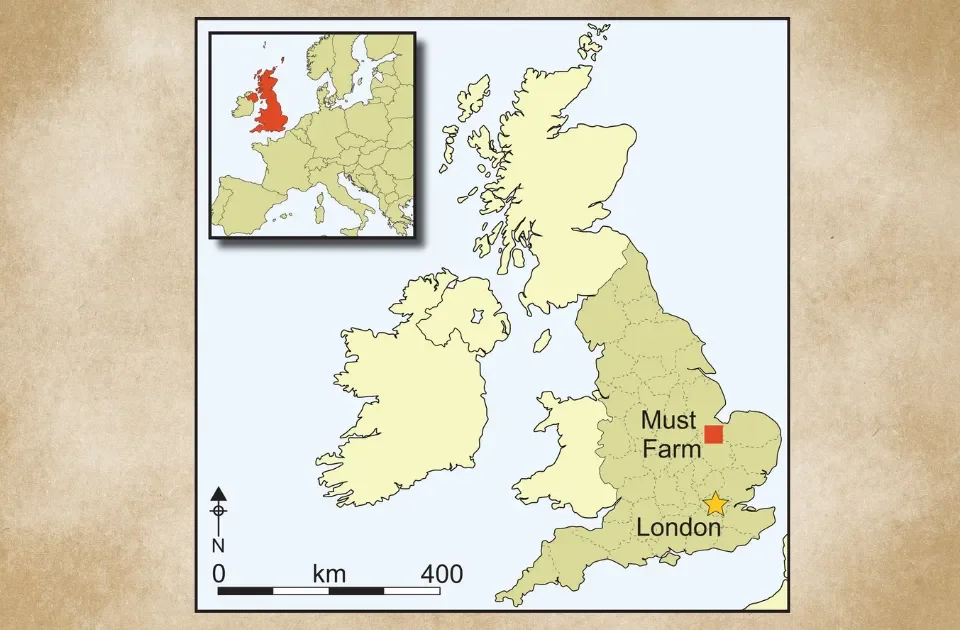
Location Map (Knight et al. 2019)
The Settlement
The settlement at Must Farm consisted of five stilted houses, also known as pile dwellings, raised about the river on wooden posts.
Building over water provided several advantages:
Protection from flooding
Fewer predators and pests
Easy access to transport networks
An environment rich in resources like fish, birds, reeds, and timber
The soft riverbed also makes it easier to insert posts securely in the ground.
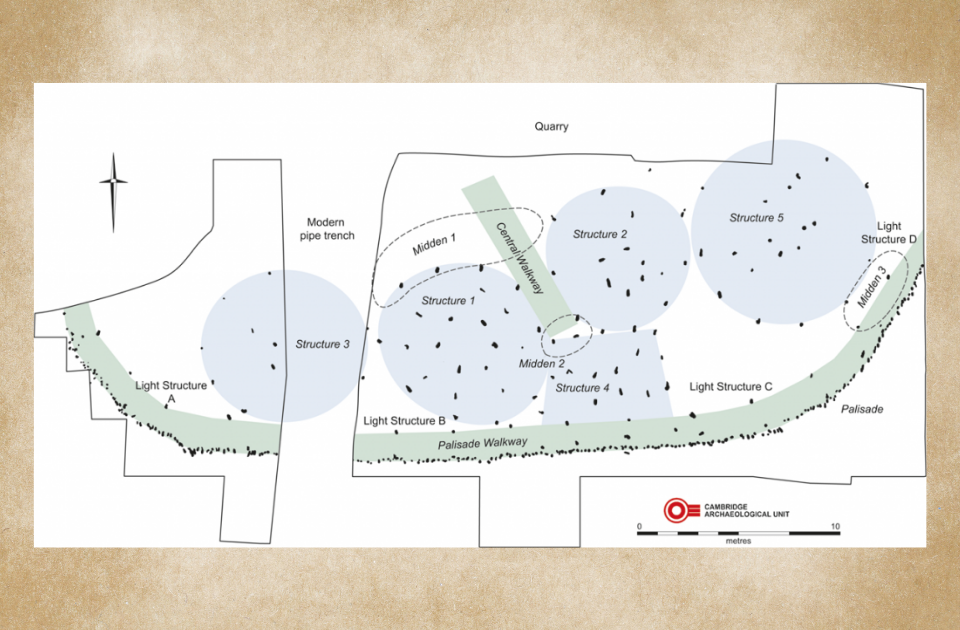
Plan of Must Farm (Must Farm)
An interesting aspect of this settlement is how short-lived it was. This isn’t a village occupied for generations. It was basically brand new with the fire occurring just nine months to a year after construction began. Much of the timber was unseasoned, meaning it had been cut down and used almost immediately. There was also a lack of insects associated with long-term habitation, and only small amounts of rubbish had accumulated.
The Fire
The houses had been constructed very close together, with roofs either touching or almost touching. If a fire started in one building, it could have spread extremely fast. Another possible cause of the fire is conflict. Weapons such as swords and spears were discovered at the site, and the settlement was built in a defensible position, surrounded by a palisade of sharpened stakes. Was the settlement attacked and deliberately burnt down? No human remains were discovered at Must Farm, suggesting the inhabitants escaped or were driven away prior to the buildings collapsing. Despite the incredible preservation, the cause of the fire remains unknown, and this may always be the case.
Painting of a campfire by Winslow Homer, 1880, for atmospheric inclusion (Public Domain, displayed in the MET). In my videos, I like to try use public domain to illustrate additional vibes, especially in a world where gen AI imagery is on the rise.
Preservation
What makes Must Farm truly exceptional is how it was preserved. Hence why the nickname ‘Britain’s Pompeii’ has stuck despite it really having no other parallels but a catastrophe and incredible preservation. When the buildings collapsed into the river, they sank into thick, waterlogged silt. This created anaerobic conditions, meaning there was no oxygen for bacteria to break the materials down. Normally, Bronze Age sites give us little more than postholes, pottery fragments, and the ocassional metal objects. However, at Must Farm, we have wood, textiles, baskets and food preserved. This is a scale of preservation rarely seen in British prehistory.
Inside a Bronze Age Home
Due to the water being slow-moving and the riverbed thick with vegetation, objects fell almost straight down as the houses collapsed. This meant artefacts were found directly beneath where they had been used, allowing archaeologists to map activity areas inside the settlement.
One building, known as Structure 1, showed clear zoning of space.
East: Metal objects appear to have been stored on the eastern side of the house.
Southeast: Textiles and bundles of fibre indicate textile working likely took place near the entrance, where natural light would have been strongest. Spinning took place in other structures, supplying yarn to Structure 1.
Southwest: Remains of young lambs and charred droppings show animals were sometimes kept inside the houses.
Northwest: Complete posts and wooden containers suggest a kitchen or cooking area. These areas are largely empty and are thought to have been sleeping areas, where bedding and furniture may not have survived.
Inside the homes were organised and intentional, laid out in a way that feels surprisingly familiar.
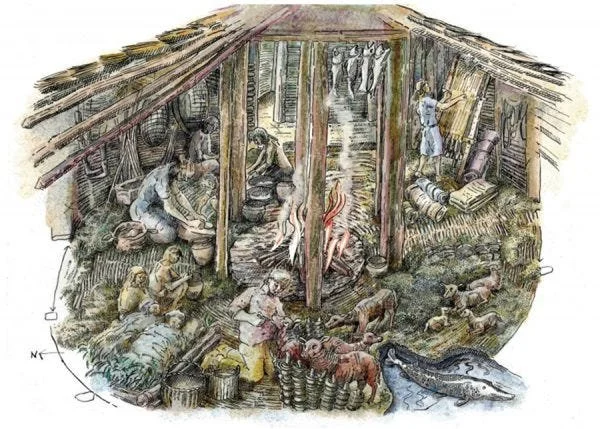
What it may have looked like inside a Bronze Age Home (Peterborough Archaeology)
Objects
Some of the most extraordinary finds at Must Farm are objects left in a moment of disaster. One of the most famous is a bowl of half-eaten porridge. The porridge was made from wheat mixed with animal fat (sheep, goat or red deer) with a wooden spoon still resting inside the bowl. Food like this rarely survives archaeologically, which makes this an incredibly intimate glimpse into daily life.
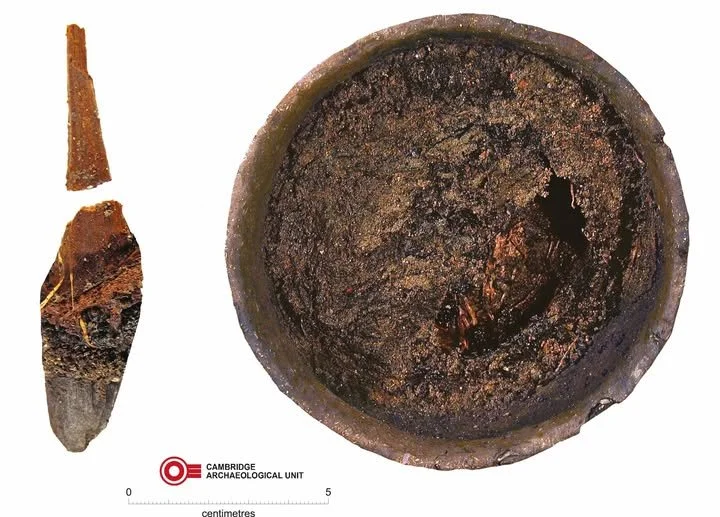
Image of the Porridge Bowl (Cambridge Archaeological Unit).
The site also produced some of the finest Bronze Age textiles ever found in Britain. A tiny, charred ball of flax thread, its strands less than half a millimetre thick, survived for nearly 3,000 years.
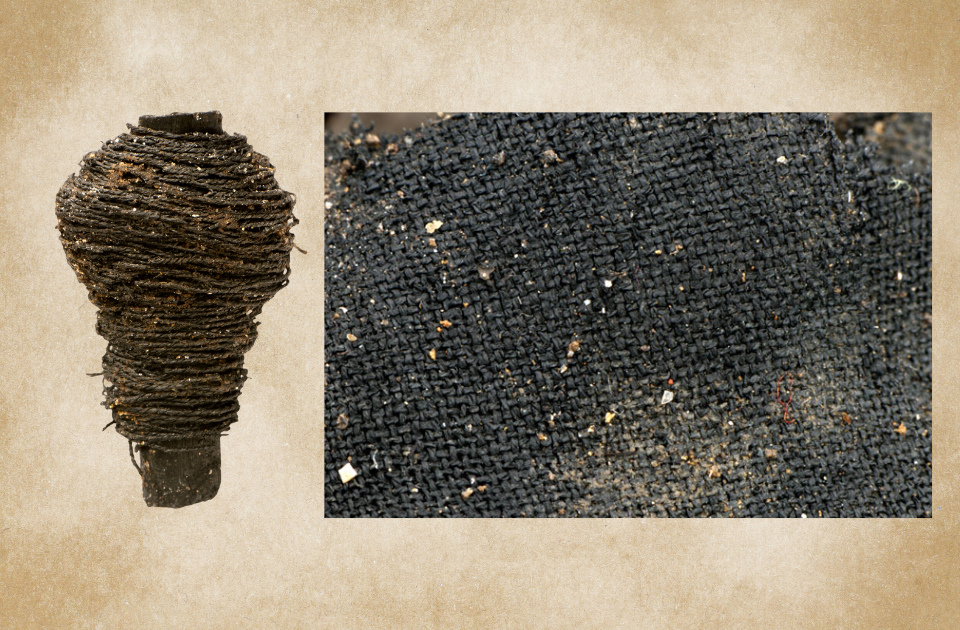
Flax Thread Ball and Piece of Fabric (Cambridge Archaeological Unit).
Beads were found across the settlement, made from glass, amber, shale and siltstone. Remarkably, some of Must Farm’s beads were likely made in Iran, around 4,500 kilometres away. This shows that Bronze Age Britain was not isolated; it was part of vast, long-distance trade networks.
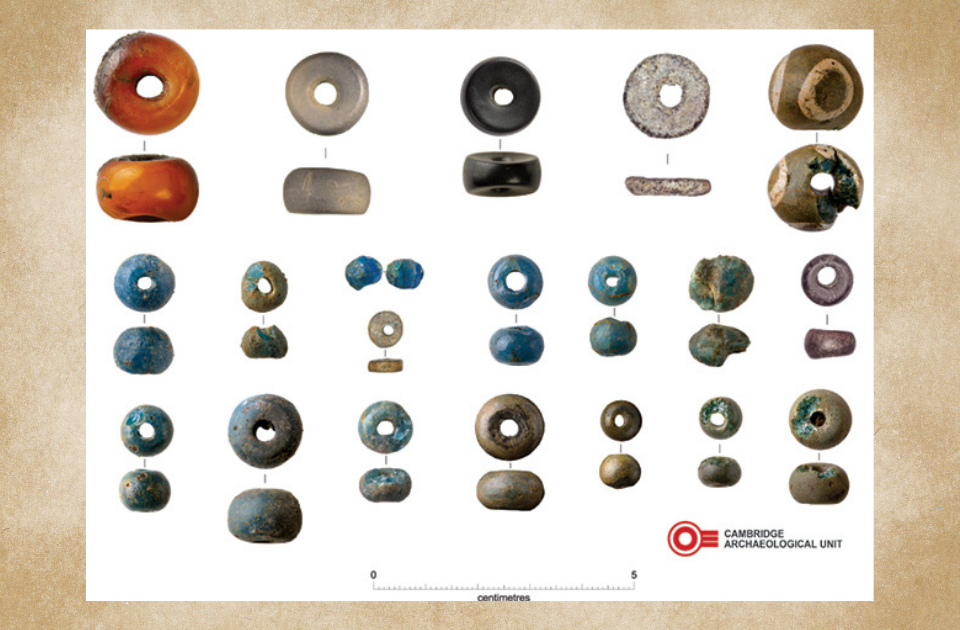
Beads of all varieties (Cambridge Archaeological Unit).
Life at Must Farm
Even less glamorous finds tell powerful stories. Studies of human and dog coprolites, fossilised faeces, revealed evidence of parasitic infections, including fish tapeworms and giant kidney worms. This represents the earliest evidence of these parasites infecting humans in Britain, reminding us that life in the Bronze Age came with real health challenges.
Craft, Recycling and Metalworking
One of the most important aspects of Must Farm is its evidence for everyday craft and recycling. Metalwork in Britain is rarely found in domestic contexts, but at Must Farm, archaeologists uncovered large, complete assemblages of tools used inside homes. These included axes, sickles, gouges and razors, forming what appears to be a standard Bronze Age household toolkit.
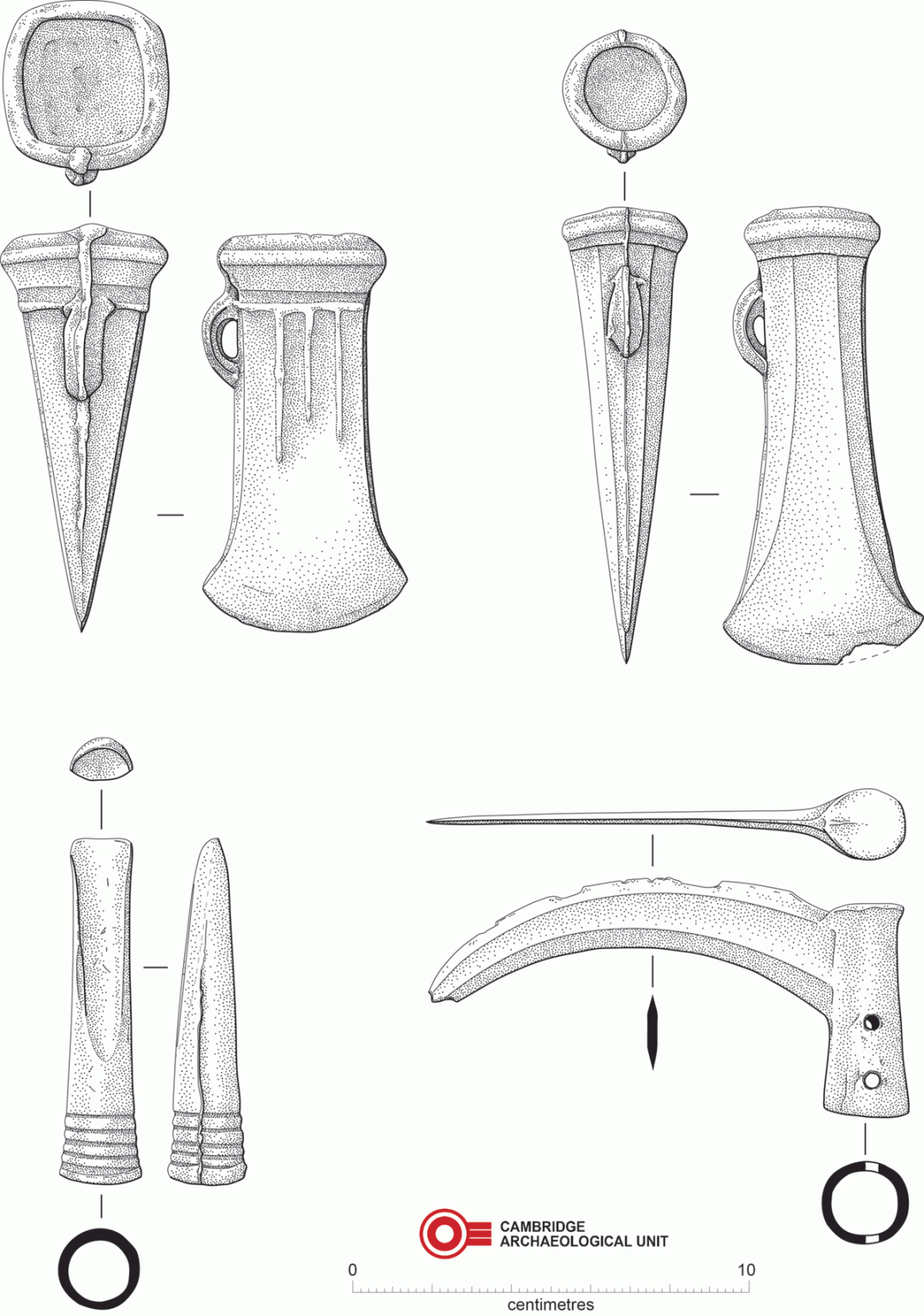
Metal Examples (Must Farm)
Textile production equipment was also widespread, with loom weights, spindle whorls, bobbins of thread and bundles of fibre present in most houses. Structure 4, a square building near the palisade, may have served as an entrance or storage area. Inside it was a wooden bucket filled with broken bronze tools and weapons, gathered together, ready to be melted down and recycled. This tells us that metal was valuable, carefully managed, and reused; nothing was wasted.
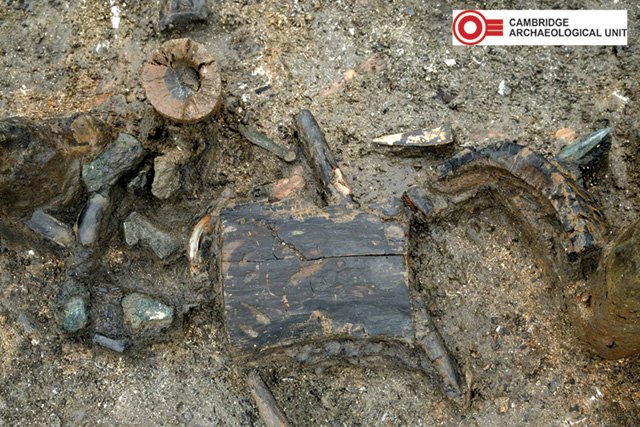
Bucket of Broken Tools (Must Farm)
Why Must Farm Matters
Must Farm doesn’t show us kings, monuments or elite burials. It shows us everyday life, cooking, working, sleeping, frozen in a single moment, and that’s what makes it extraordinary. Sites like this reshape how we understand prehistoric life, reminding us that ordinary people and their daily routines are just as important as the spectacular and the monumental. Thank you for reading this post. Comment on what you think of life at Must Farm. Please like and subscribe for more archaeology content. You can also find me on Instagram, TikTok and YouTube.
To Learn More…
Definitely check out the Must Farm website; there are links to the other publications and dig diaries, which are incredible resources: https://www.mustfarm.com/bronze-age-settlement/about/
There are also some longer documentaries on YouTube and an episode of Digging For Britain:
More general reading about the Bronze Age
‘The Horse, the Wheel, and Language: How Bronze-Age Riders from the Eurasian Steppes Shaped the Modern World’ by David W. Anthony
‘50 Bronze Age Finds: From the Portable Antiquities Scheme’ by Dot Boughton
Please note that some of these links may be affiliate, meaning if you buy it at no extra cost to you, I get a small commission.
